Launch offer — valid today only

📄 Digital book in PDF · read it on your phone or print it

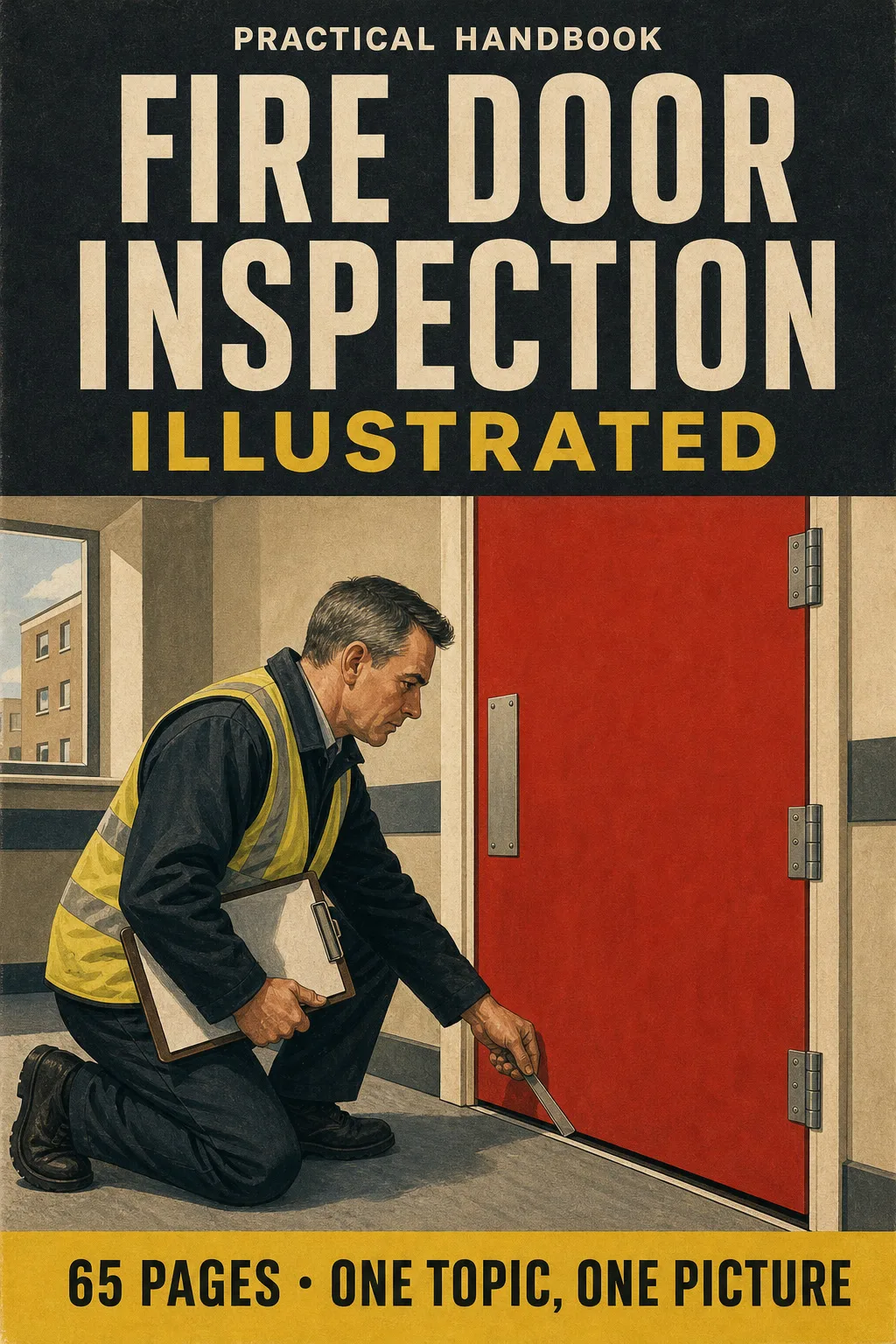
Fire Door Inspection and Regulation 10 Checks, Illustrated Every Door in the Same Order

Doorset anatomy, FD30 and FD60 ratings, gaps and thresholds, intumescent and smoke seals, hinges and self-closers, hold-open devices, fire-rated glazing, signs and defect reporting. Every topic has its own page: the drawing first, then what you need to remember. 65 illustrated pages.

START STUDYING THIS WAY

🔒 Secure checkout · PDF by email · 30-day guarantee
Every topic, its own pageEach check drawn, with the explanation alongside
65 illustrated pages9 parts, from what a fire door actually does to your course assessment
Up-to-date sourcesFire Safety (England) Regulations 2022, Approved Document B (2019 edition, as amended) and BS 8214:2016
PDF by emailFormat

Look Inside the Book

Every page has one large drawing and a box with the gaps, numbers and decisions you need to know:

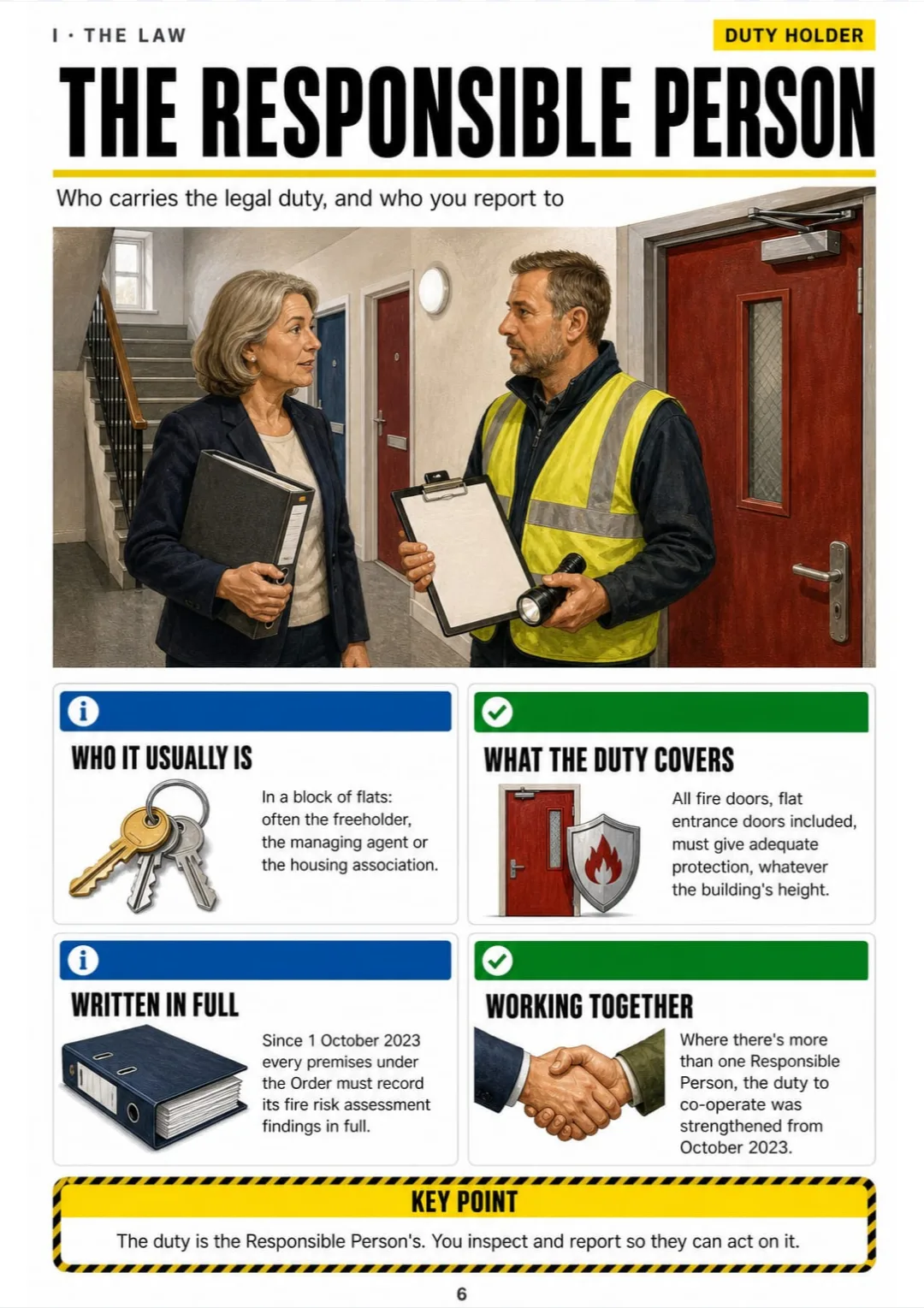
Under the Fire Safety Order 2005, fire doors must give adequate protection at any building height.
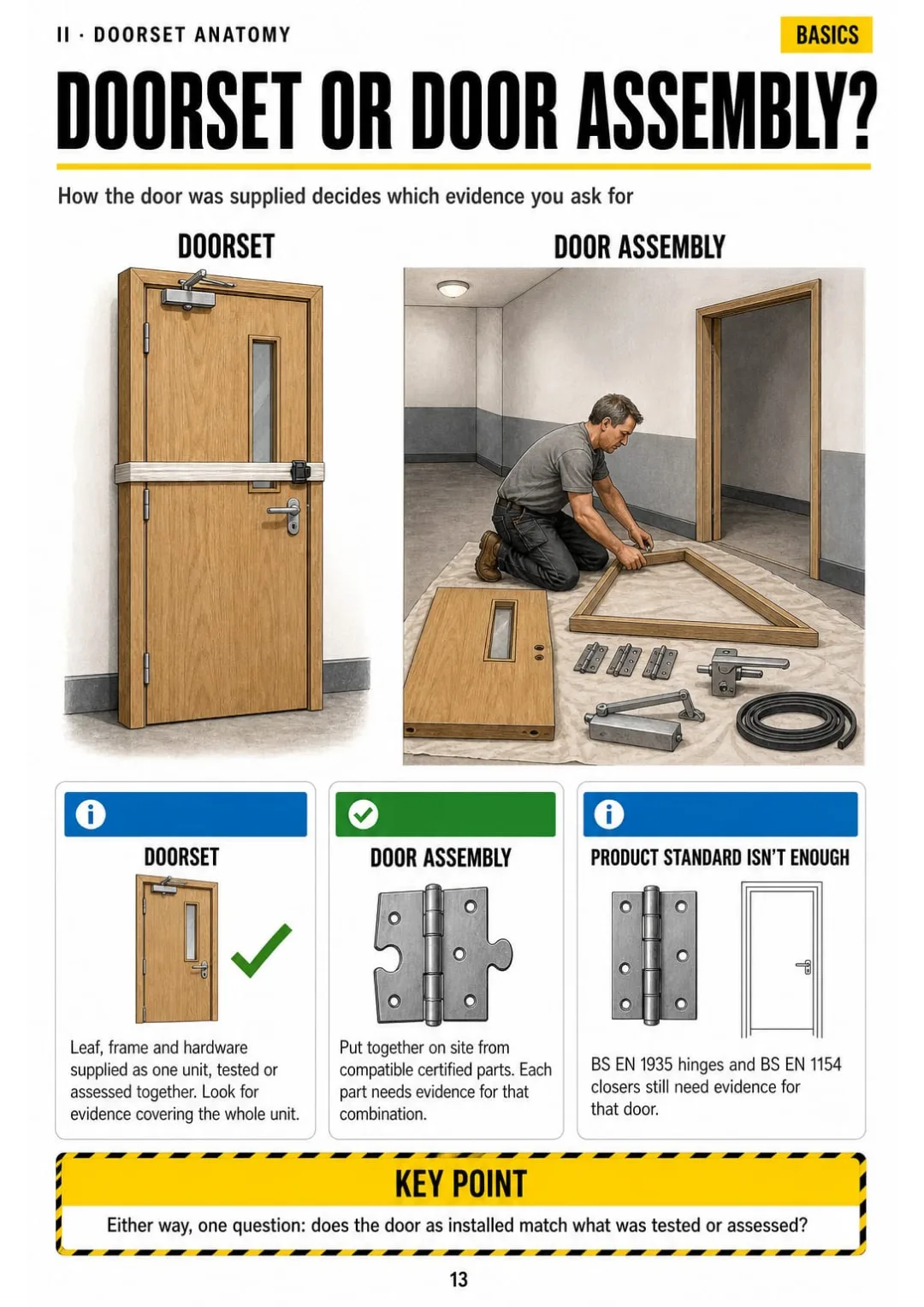
Doorset = one tested unit · door assembly = certified parts built on site
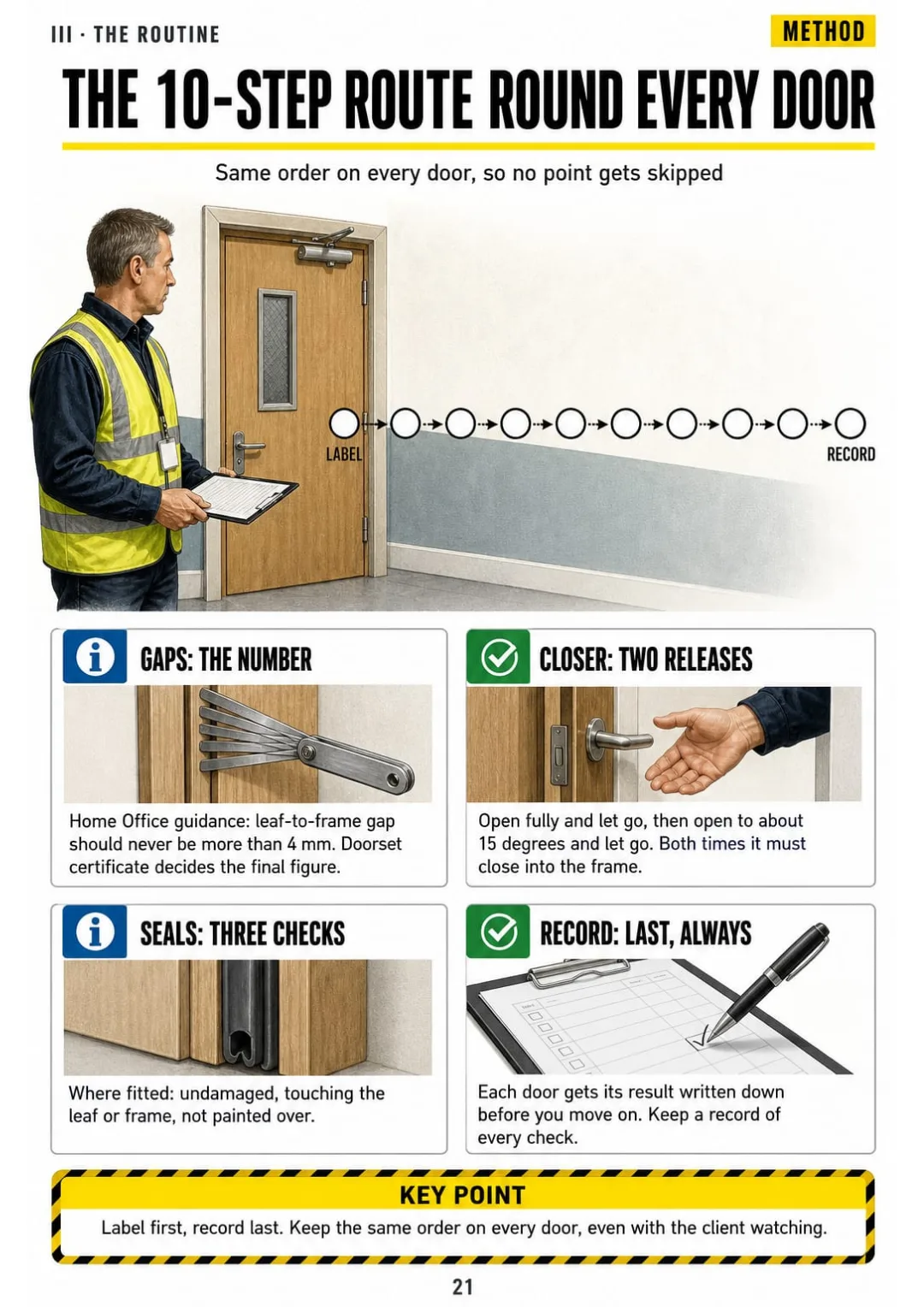
Label → frame → leaf → gaps → seals → hinges → closer → glazing → signage → record.
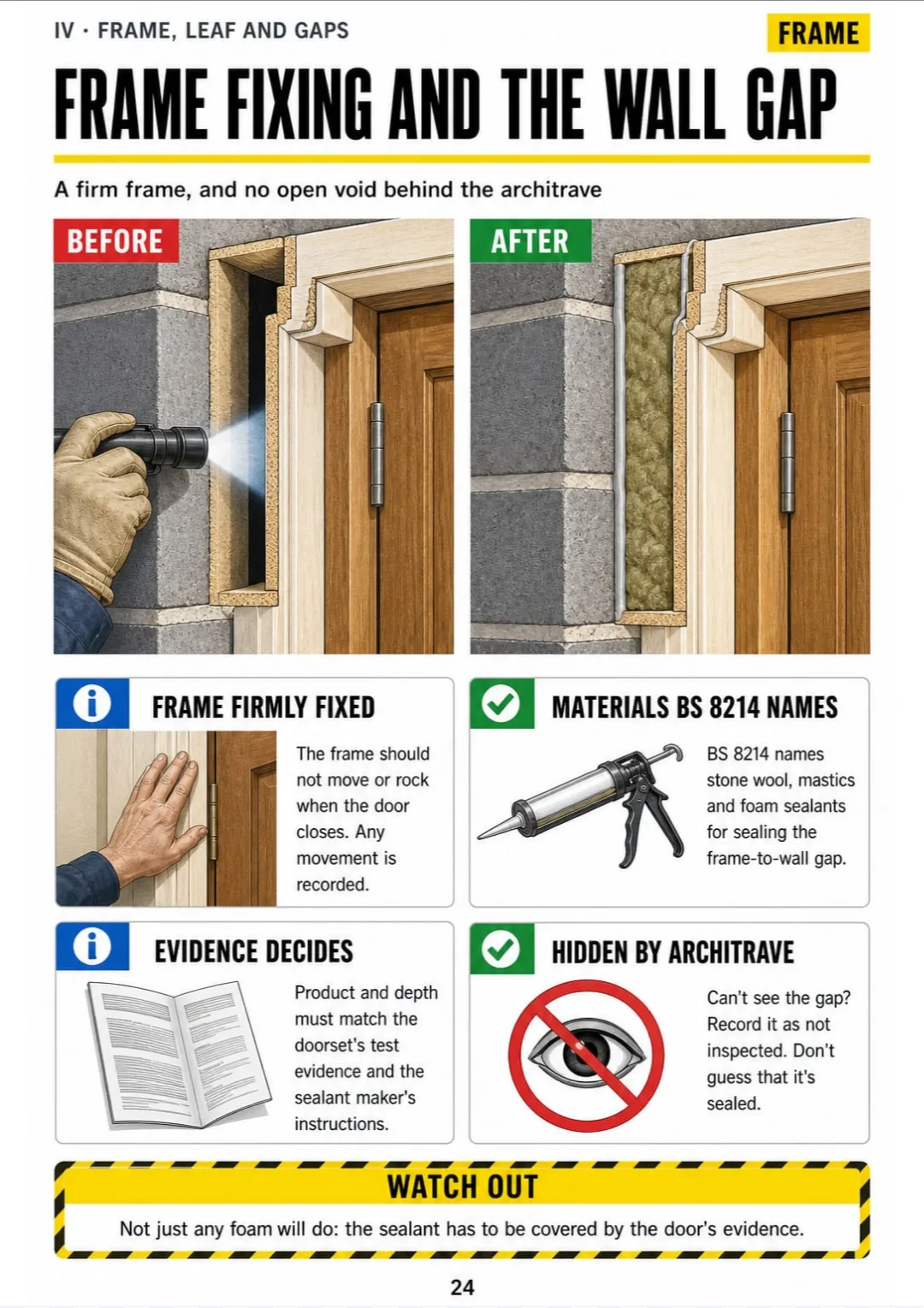
Frame-to-wall gap: sealed with a product covered by the doorset's evidence (BS 8214:2026).
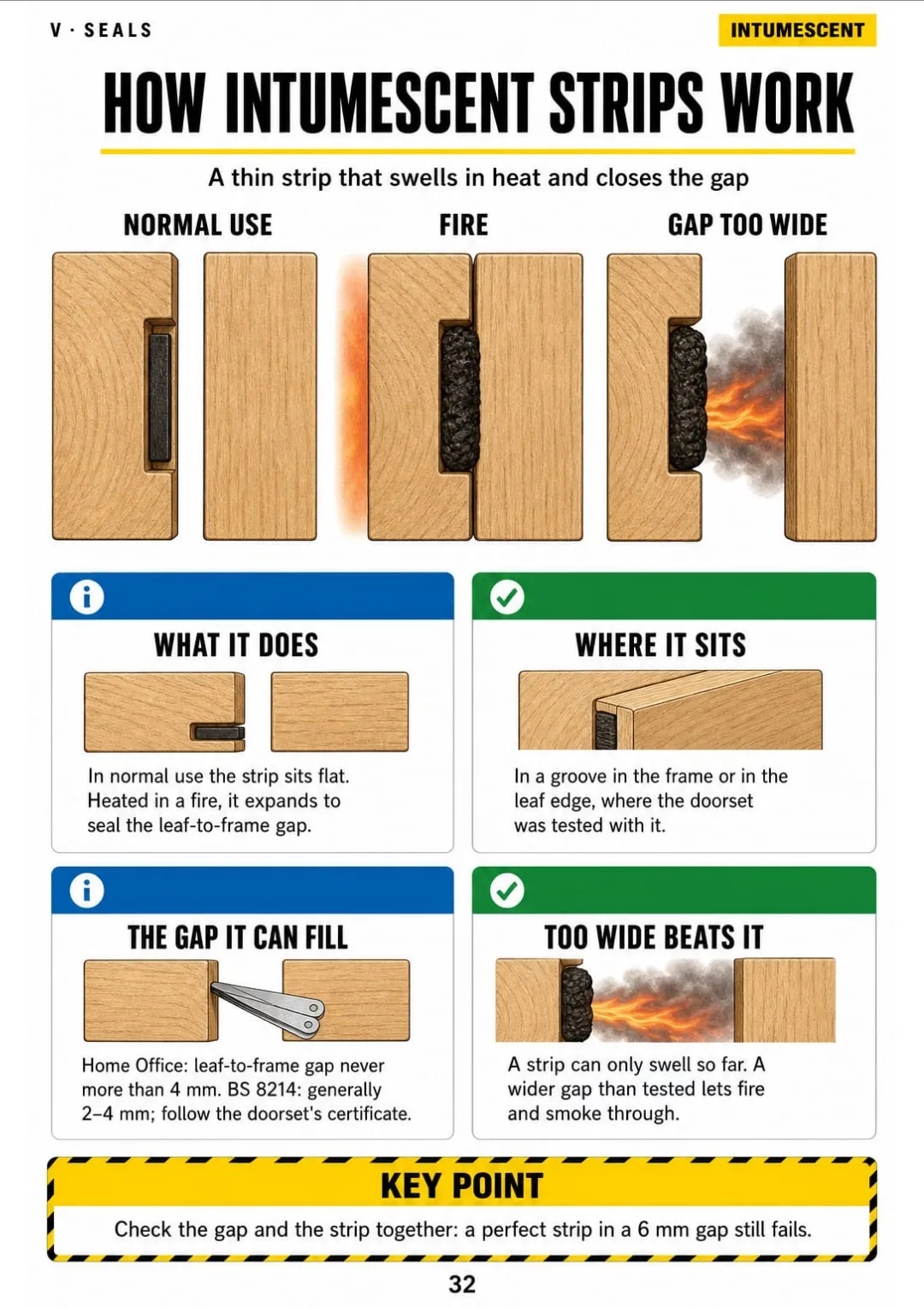
Intumescent strip cold vs expanded, and why gaps over 4 mm beat it
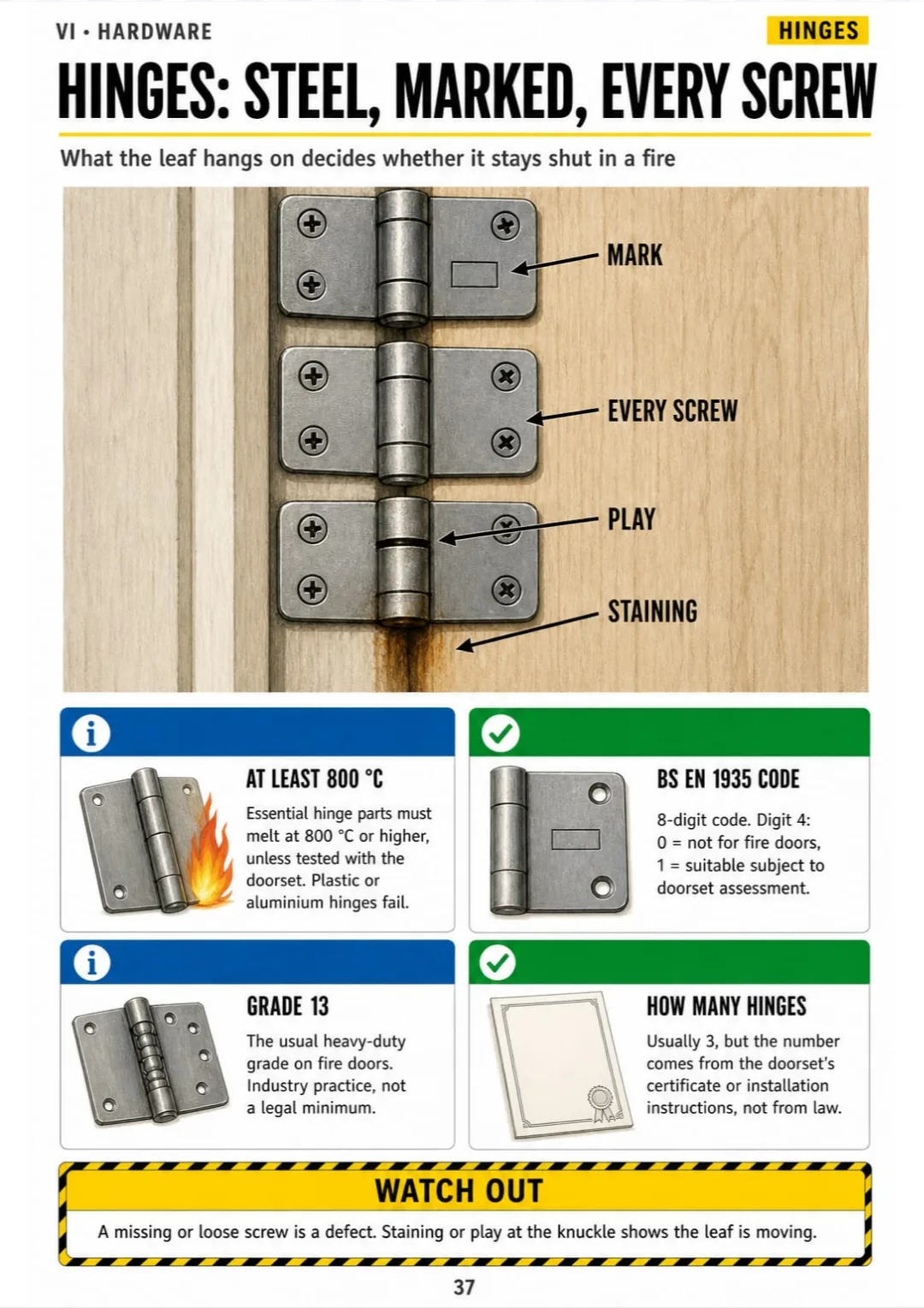
Fire door hinges: 800 °C minimum, BS EN 1935 digit 4, every screw in place
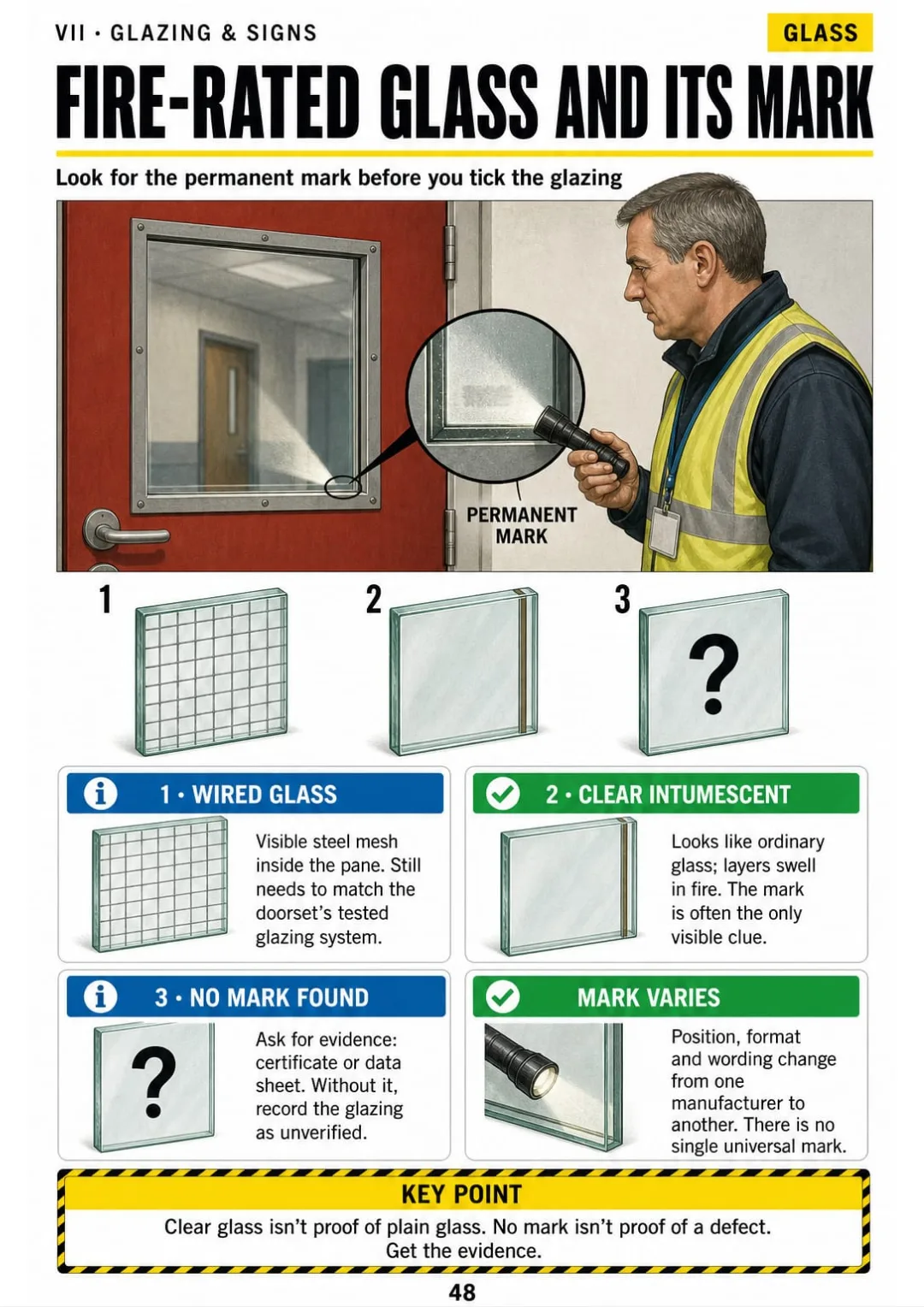
Wired, clear intumescent or unmarked: how to check fire-rated glass and what to record
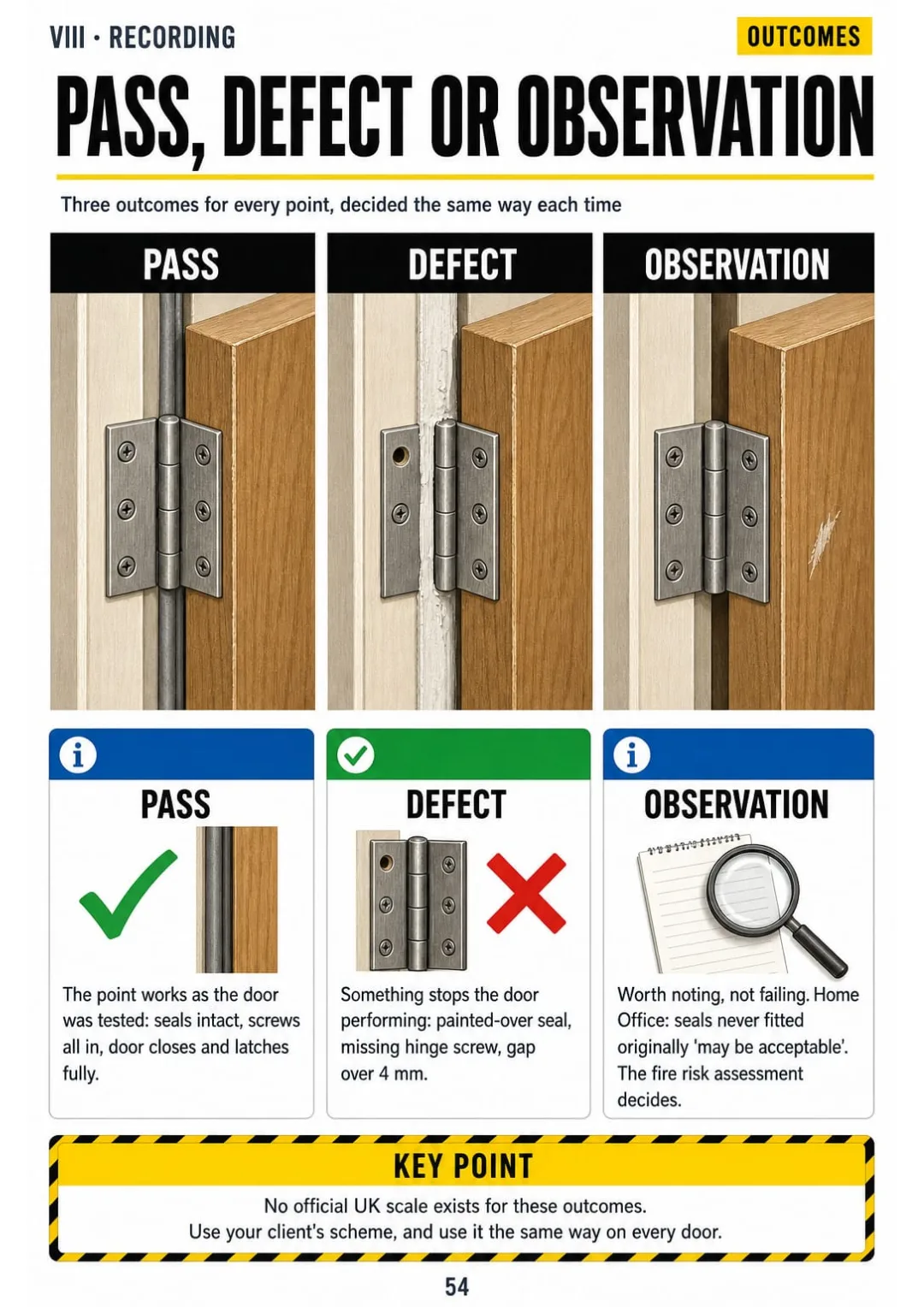
Pass, defect, observation: three outcomes, each with a drawn example

Swipe to see more →

These are real pages from the book. The table of contents is the full one: 9 parts and 61 topics.

The Problem Isn't You. It's How It Was Explained to You.

You're on a third-floor landing with a clipboard, the managing agent beside you and a flat entrance door to sign off. You start at the hinges, jump to the closer, then realise you never checked the label.

It's not a lack of experience: you've hung hundreds of doors. The guidance deals with labels, gaps, seals and closers in separate clauses and paragraphs, so nobody ever hands you the order to check them in.

Label → frame → leaf → gaps → seals → hinges → closer → glazing → signage → record.

In the book, that route is one page: the door drawn once, with ten numbered stops. Label, frame, leaf, gaps, seals, hinges, closer, glazing, signage, record. Same order, door after door.

The rest works the same way. Gaps at the head and threshold, painted seals, the self-closer test, fire-rated glass, defect priorities: each one on its own page, drawn.

At the next door you walk the ten steps without wondering what comes next. You spot the defect, you know what to write, and the manual stays in the van.

COMPARE FOR YOURSELF

The Same Topic, Two Ways to Study It

THIS
  • The manual: line after line
  • Doorsets and door assemblies explained only in words
  • You get to the door still unsure
A fire-resisting doorset shall be understood as a complete unit comprising the door leaf or leaves, frame, ironmongery, seals and any glazing, supplied by a single manufacturer and tested and certified as an integral assembly, whereas a door assembly denotes a combination of separately sourced components, each of which must be demonstrated, by reference to the relevant test evidence or field of application, to be compatible with the others, and installed on site in accordance with the specification under which the fire performance of the combination has been assessed.
FOR THIS
  • Doorset vs door assembly in one drawing
  • The evidence to look for in a box
  • What to ask for: the label or plug, the certificate, the field of application
Doorset = one tested unit · door assembly = certified parts built on site
CONTENTS

Take a Look at the 9 Parts and 61 Topics

The law in plain English, doorset anatomy and ratings, the 10-step routine, frame, leaf and gaps, seals, hinges, hardware and closers, glazing and signs, recording and prioritising, and revision: 65 pages, all illustrated.

IThe law in plain English · pp. 5-12
  1. What a fire door actually does
  2. The Fire Safety Order 2005 and the Responsible Person
  3. Fire Safety Act 2021: flat entrance doors are in scope
  4. Regulation 10: the 3-month and 12-month checks
  5. Telling residents about fire doors
  6. Where Approved Document B asks for fire doors in flats
  7. England, Wales, Scotland, Northern Ireland
  8. Competence: what an inspector is and isn't
IIDoorset anatomy and ratings · pp. 13-20
  1. Doorset or door assembly?
  2. Every part, named
  3. FD30, FD60 and the letter S
  4. British vs European ratings
  5. Finding the certification label or plug
  6. Leaf thickness and what it tells you
  7. What's inside the leaf
  8. Evidence: certificates, data sheets and installation records
IIIThe routine, always in the same order · pp. 21-23
  1. The 10-step route round every door
  2. The inspection kit
  3. Communal doors vs flat entrance doors
IVFrame, leaf and gaps · pp. 24-31
  1. Frame fixing and the gap to the wall
  2. Door stop: depth and damage
  3. Leaf damage: holes, splits, delamination
  4. Unauthorised alterations
  5. Measuring the gaps at sides and head
  6. The threshold gap
  7. Pairs of doors: the meeting edges
  8. A dropped or binding leaf
VIntumescent and smoke seals · pp. 32-36
  1. How intumescent strips work
  2. Smoke seals: brush, fin and combined
  3. Painted seals: defect or not?
  4. Missing, broken or wrong seals
  5. Seals at hardware, letter plates and glazing
VIHinges, hardware and closers · pp. 37-47
  1. Hinges: steel, marked, every screw
  2. Locks and latches
  3. Handles, pull handles and push plates
  4. Letter plates and spyholes
  5. The self-closer test
  6. Closer speed and adjustment
  7. Concealed and chain closers
  8. Hold-open devices and wedges
  9. Free-swing closers
  10. Pairs: the door co-ordinator
  11. Access control and maglocks
VIIGlazing, signs and surroundings · pp. 48-53
  1. Fire-rated glass and its mark
  2. Glazing beads and the glazing system
  3. Side panels and fanlights
  4. Fire safety signs
  5. Air transfer grilles
  6. What's around the door
VIIIRecording and prioritising · pp. 54-59
  1. Pass, defect or observation
  2. Giving a defect its priority
  3. Photographing a defect
  4. Writing one clear defect line
  5. When a resident refuses access
  6. Inspect, repair, re-inspect
IXRevision and frequent mistakes · pp. 60-65
  1. The 10 steps on one page
  2. The numbers to have at hand
  3. Which standard covers what
  4. The most frequent defects, before and after
  5. Frequent inspection mistakes
  6. Before your course assessment

One Page, One Topic, All Clear

Think of it this way:

It's the quarterly round in a block of flats. A communal door on the second floor closes, but the gap at the head looks wider than at the hinges, and you have to decide whether that's a defect before you move on.

You open the page on measuring the gaps at sides and head: the leaf drawn with the gauge at each point, the figure to check and the decision right next to it.

Intumescent strip cold vs expanded, and why gaps over 4 mm beat it

The same goes for the threshold gap, painted seals, the self-closer test, hold-open devices and fire-rated glass: each one on its own page.

Fire Door Inspection Illustrated is 9 parts and 61 topics, all drawn, with the numbers to have at hand, the most frequent defects before and after and a revision section at the end.

What you see drawn, you don't have to memorize.

What's Inside Fire Door Inspection Illustrated:

Ipp. 5-12

The law in plain English

The legal side in plain English, so you know who must check what and how often: what a fire door does, the Fire Safety Order and the Responsible Person, the Fire Safety Act 2021, Regulation 10's 3-month and 12-month checks, informing residents, Approved Document B, the four UK nations and what competence means.

IIpp. 13-20

Doorset anatomy and ratings

Doorset or door assembly, every part named, FD30, FD60 and the letter S, British vs European ratings, finding the label or plug, leaf thickness, what's inside the leaf and the evidence to ask for.

IIIpp. 21-23

The routine, always in the same order

The part you'll use at every door: the 10-step route from label to record, the inspection kit, and what changes between communal doors and flat entrance doors.

IVpp. 24-31

Frame, leaf and gaps

Frame fixing and the gap to the wall, the door stop, leaf damage, unauthorised alterations, measuring the gaps at sides, head and threshold, pairs of doors and a dropped or binding leaf.

Vpp. 32-36

Intumescent and smoke seals

How intumescent strips work, brush, fin and combined smoke seals, painted seals, missing or wrong seals and seals around hardware, letter plates and glazing.

VIpp. 37-47

Hinges, hardware and closers

Hinges, locks and latches, handles and push plates, letter plates and spyholes, the self-closer test and adjustment, concealed and chain closers, hold-open devices, free-swing closers, co-ordinators and maglocks.

VIIpp. 48-53

Glazing, signs and surroundings

Fire-rated glass and its mark, glazing beads, side panels and fanlights, fire safety signs, air transfer grilles and what's around the door.

VIIIpp. 54-59

Recording and prioritising

So every door ends with a record anyone can act on: pass, defect or observation, giving a defect its priority, photographing it, writing one clear defect line, refused access and the inspect, repair, re-inspect cycle.

IXpp. 60-65

Revision and frequent mistakes

The 10 steps on one page, the numbers to have at hand, which standard covers what, the most frequent defects before and after, frequent inspection mistakes and a page for before your course assessment.

At the end of the book: The numbers to have at hand, which standard covers what and the most frequent defects drawn before and after.

Plus: 2 Free Books

Fire Door Exam-Style Questions, with Answers Explained

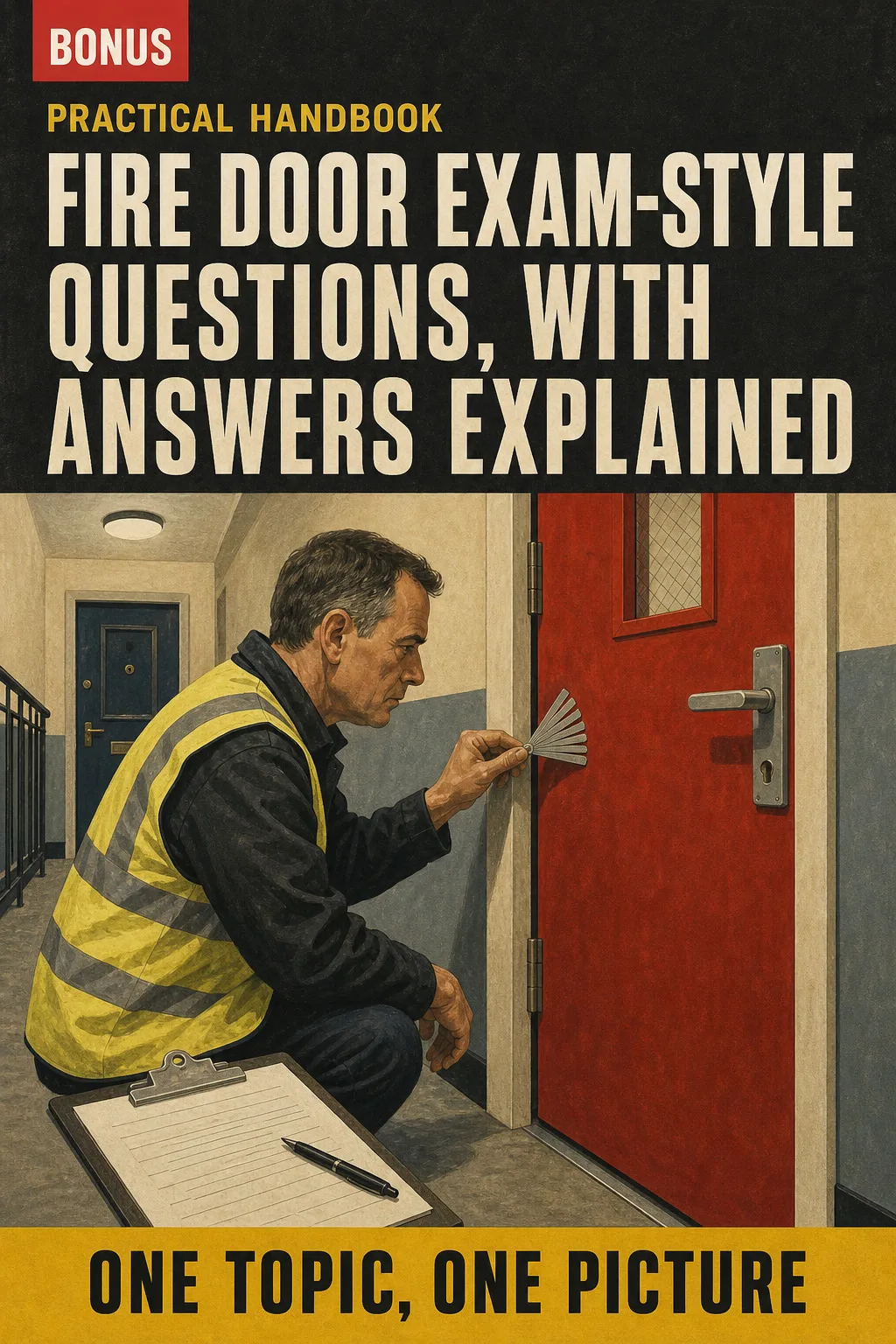
BONUS 1: «Fire Door Exam-Style Questions, with Answers Explained»

Value on its own: US$ 17.90

Practise with exam-style questions on ratings, gaps, seals, closers and reporting, each answer explained with the page it comes from, so you know exactly what to revise.

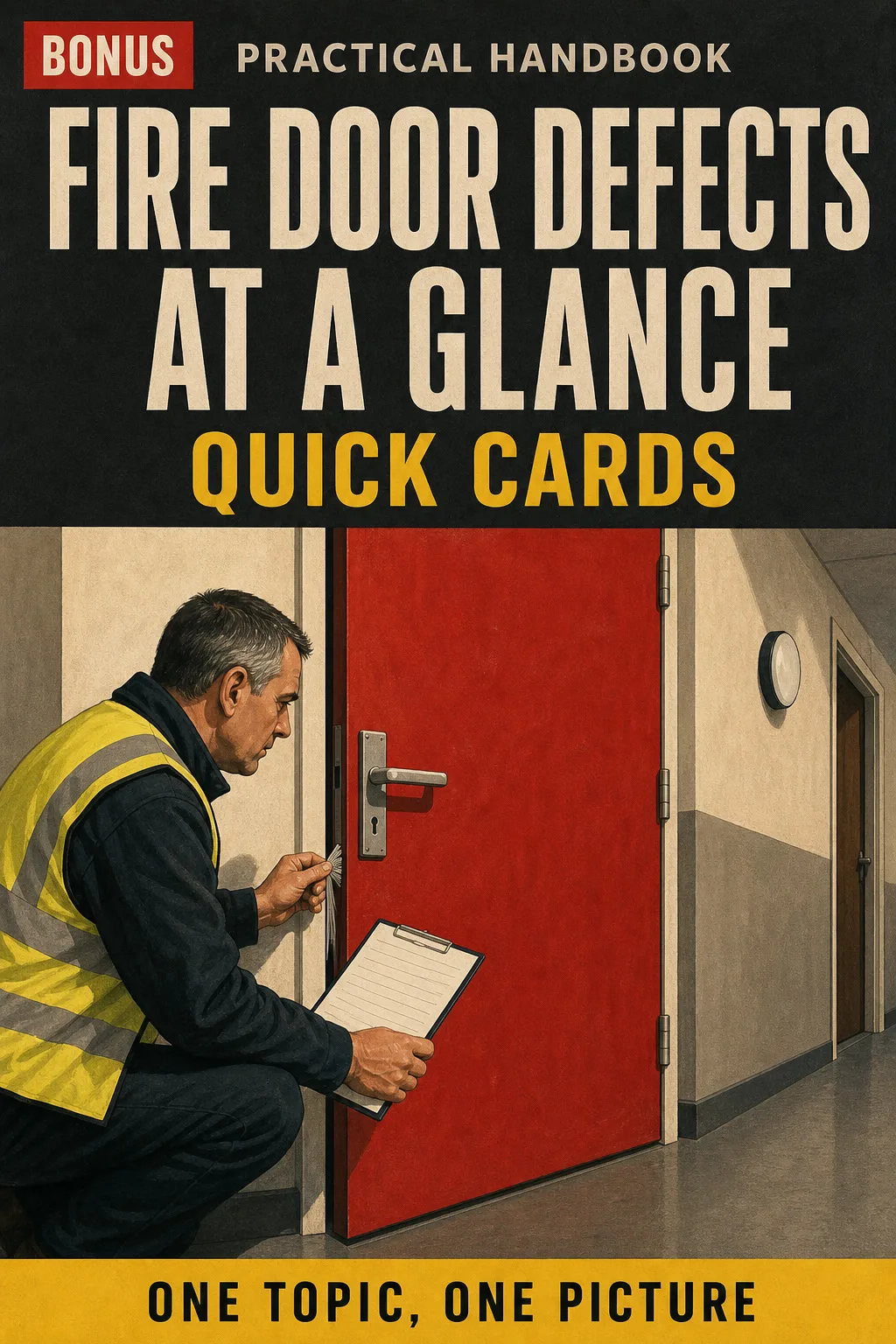
Fire Door Defects at a Glance: Quick Cards

BONUS 2: «Fire Door Defects at a Glance: Quick Cards»

Value on its own: US$ 14.90

The most frequent fire door defects on printable cards, each drawn before and after with the decision to take, to keep in your van or on your clipboard.

Fire Door Inspection Illustrated with 2 Free Books

  • Fire Door Inspection Illustrated: 65 illustrated pagesUS$ 63
  • BONUS 1: Fire Door Exam-Style Questions, with Answers ExplainedUS$ 17.90
  • BONUS 2: Fire Door Defects at a Glance: Quick CardsUS$ 14.90
  • High-resolution PDF to printIncluded
Total value US$ 95.80
YOUR PRICE:
US$ 27
You save US$ 68.80
YES, I WANT FIRE DOOR INSPECTION ILLUSTRATED FOR US$ 27

📄 This is a digital PDF book sent to your email: nothing is printed or shipped.

Secure purchaseEncrypted payment30-day guarantee

PDF by email: We email you Fire Door Inspection Illustrated as a PDF, together with the two free books. It's a single payment: no installments, no extra charges.

Who This Book Is For

You're on a fire door inspection course

You're on a fire door inspection course

Each module topic has its own drawn page, so the course content lands in the same order you'll check a real door.

Your course assessment is coming up

Your course assessment is coming up

The 10 steps on one page, the numbers to have at hand and which standard covers what: a quick, ordered revision before the day.

You already do the checks in a block of flats

You already do the checks in a block of flats

Print the pages you need, take them on your round and record every door the same way, with the right priority for each defect.

Everything You Get Today

US$ 95.80US$ 27
YES, I WANT FIRE DOOR INSPECTION ILLUSTRATED FOR US$ 27

📄 This is a digital PDF book sent to your email: nothing is printed or shipped.

30DAYS
GUARANTEE

30-Day Guarantee

Try Fire Door Inspection Illustrated for 30 days, bonus books included.

We refund everything if the file won't open, if the book isn't what you see here, if you were charged twice or if the email doesn't arrive. Just email us.

You pay once. No subscriptions.

Frequently Asked Questions

Is it for me if I've been hanging fire doors for years?

Yes. It doesn't teach you joinery: it puts the inspection in order, from label to report, with what counts as a defect and how to record it. Your experience with the door is the starting point.

Where does the content come from?

From the Regulatory Reform (Fire Safety) Order 2005, the Fire Safety Act 2021, the Fire Safety (England) Regulations 2022 and the Home Office guidance on Regulation 10, Approved Document B Volume 1 (2019 edition, as amended), BS 8214:2016 and the hardware product standards such as BS EN 1935. Figures and standard numbers are checked against those versions.

Is it official material?

No. It's an independent illustrated study book, not linked to any government body, awarding body or certification scheme. Regulation 10 applies in England; Scotland, Wales and Northern Ireland have their own frameworks, covered on their own page.

Does it replace my course or certification?

No. It doesn't replace an accredited course, certification, manufacturer's instructions or the judgement of a competent inspector, and it doesn't give you a certificate. It covers the topics in the index on this page, so you can check them against your course syllabus and keep what you learn in order.

Are the practice questions the ones in the exam?

No. They're written for this book, in the style of the questions most asked on ratings, gaps, seals, closers and reporting, with each answer explained and the page it comes from.

When and how will I get it?

The book and the 2 free books arrive as PDFs by email, at the address you enter at checkout.

Do I have to pay every month?

No. It's a one-off payment.

Can I have it on paper?

Yes. It's a PDF ready to print: you can print the whole book or just the pages you want on your clipboard or in the van.

How does the refund work?

You have 30 days. We refund everything if the file won't open, if the book isn't what you see on this page, if you were charged twice or if the email doesn't arrive: just email us.

Before You Close This Page

No more rereading clauses without anything sticking.

The head gap, the seals, the closer: you see them drawn and that's it.

You get to every door, and to your assessment, knowing where everything is.

Drawings make studying faster.

The book is right below.

One-time payment: US$ 27 · Guarantee: 30 days · PDF by email

YES, I WANT FIRE DOOR INSPECTION ILLUSTRATED FOR US$ 27

📄 This is a digital PDF book sent to your email: nothing is printed or shipped.